
The Future of Business Analysis in the Age of AI: 5 Tools Every Analyst Should Embrace
As artificial intelligence rapidly reshapes the business landscape, the role of the business analyst (BA) is undergoing a profound transformation. No longer confined to traditional requirements gathering or stakeholder documentation, the modern BA is evolving into a strategic partner—leveraging data, automation, and machine intelligence to drive value.
To stay ahead, business analysts must expand their toolkit. The future isn’t about being replaced by AI; it’s about being augmented by it. Here are five essential tools and capabilities that will enrich a business analyst’s role in the AI-driven future:
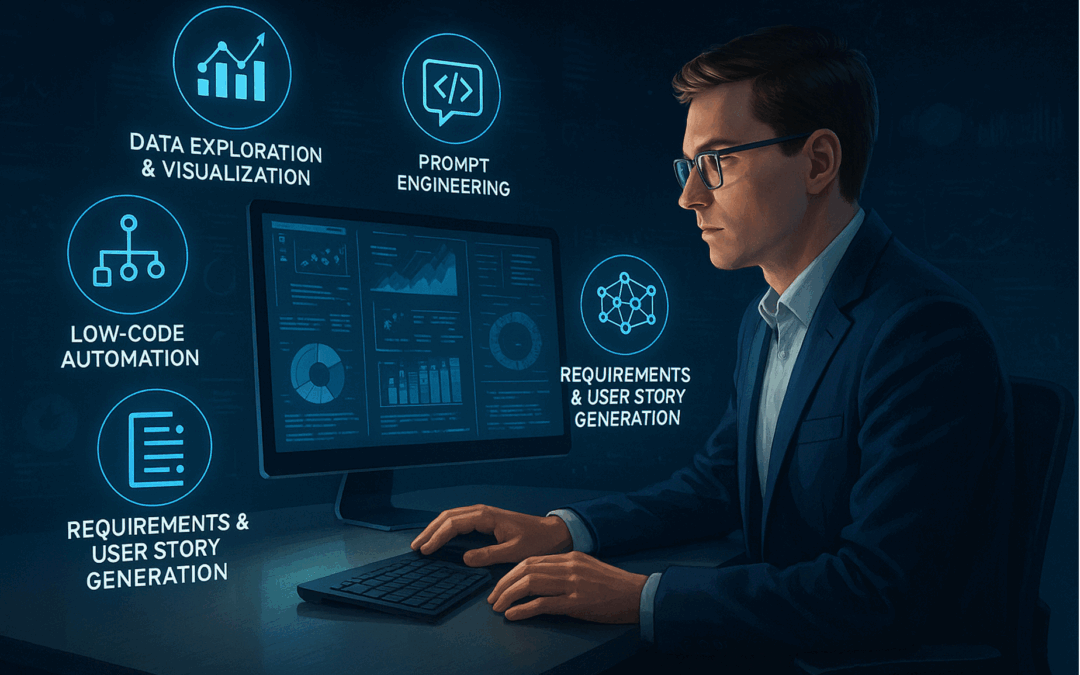
- AI-Powered Data Exploration & Visualization (e.g., Power BI + Copilot, Tableau GPT)
Why it matters: Business analysts are increasingly expected to work with large, complex data sets and tell compelling, actionable stories. Tools like Microsoft Power BI with Copilot and Tableau GPT combine natural language with automated insights, allowing BAs to query data conversationally, uncover trends faster, and deliver visualizations that speak to both executives and data scientists.
How to use it: Learn how to ask the right questions of your data using plain language. Focus on scenario analysis, anomaly detection, and forecasting capabilities to move from descriptive to predictive and prescriptive analytics.
- Prompt Engineering with Generative AI (e.g., ChatGPT, Claude, Perplexity)
Why it matters: Prompt engineering is becoming a foundational skill across industries. For business analysts, it enables you to rapidly draft documentation, brainstorm product features, simulate customer journeys, or even generate business cases—all at lightning speed.
How to use it: Invest time in learning how to craft effective prompts. Understand chain-of-thought reasoning, structured input-output formats, and tone adaptation. Use AI tools to co-create rather than automate.
- Low-Code / No-Code Automation (e.g., Power Automate, Zapier, UiPath StudioX)
Why it matters: As organizations look to streamline operations, BAs are being called upon to design process automations. Low-code platforms empower analysts to prototype and deploy automated workflows without waiting on IT.
How to use it: Focus on automating repetitive processes like approvals, notifications, or data syncing. Mastering the logic of workflow design will elevate your value as a BA who doesn’t just document processes but improves them.
- AI Model Collaboration & Interpretation Tools (e.g., IBM Watson Studio, Azure ML, DataRobot)
Why it matters: Analysts aren’t expected to build deep learning models from scratch—but they are expected to interpret, validate, and communicate model outputs to business stakeholders. Collaborative ML platforms let BAs act as interpreters between data scientists and decision-makers.
How to use it: Learn how to evaluate models for fairness, accuracy, and bias. Use Explainable AI (XAI) features to confidently speak to what a model is doing and why it matters. Become the bridge between black-box models and business trust.
- AI-Powered Requirements & User Story Generation (e.g., ChatGPT custom GPTs, Jira AI Assistants)
Why it matters: Requirement elicitation and documentation—core BA responsibilities—can now be enhanced by AI. From generating user stories in Jira to refining epics and acceptance criteria, AI can cut through ambiguity and help scale quality faster.
How to use it: Use AI to generate initial drafts of user stories, then refine through stakeholder workshops. Focus on aligning user needs with business value, while allowing AI to assist with traceability, coverage, and versioning.
Final Thoughts: Business Analysts as AI Translators
In this new era, the business analyst is no longer just a documenter—they are a translator between people, processes, and algorithms. The most successful analysts won’t be those with the deepest technical knowledge, but those who can ask smart questions, design human-centered processes, and harness AI to deliver measurable outcomes.
Adapting to AI isn’t optional. But it doesn’t require reinvention—it requires reimagination.
